
INTELLIGENT TRACKING SOLUTIONS
Skyline
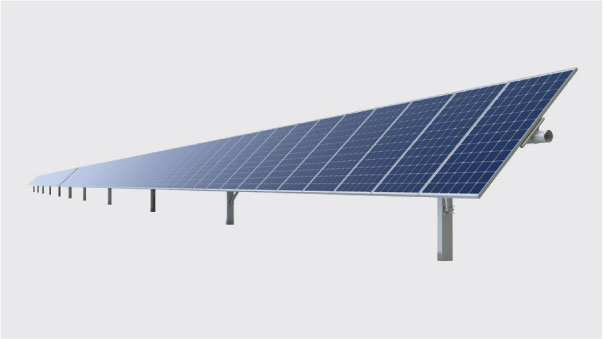
Description:
Independent Row 1P Tracker, Stable, Reliable, Cost-effective
The SkyLine tracking system is a single-row tracking system developed by Arctech, which can adapt to a continuous slope of N-S 20% and has strong wind resistance. The standard product of the SkyLine tracking system supports 90 solar modules which could be adjusted according to string configuration and topography. The SkyLine tracking system uses a patented D-tube , long-distance low-power LoRa wireless transmission technology, string-powered supply with lithium battery backup. At the same time, this product perfectly fits Arctech’s new-generation artificial intelligence PV tracking solution, which can enable the PV power plant to obtain up to 7% of additional energy yield.
| SKYLINE TRACKER SPECIFICATIONS | |
|---|---|
| Tracking Type | Independent horizontal single-axis tracker |
| Tracking Range | 士 60° |
| Driving System | Slew drive, 28VDC motor |
| Modules per Tracker | Up to 90 modules per tracker |
| System Voltage | 1000 V or 1500 V |
| Ground Coverage Ratio | Typical ≥ 25% |
| Foundation Options | All foundation types |
| Terrain Adaption | Up to 20% N-S slope |
| Structure Material | Hot dipped galvanized/Pre-galvanized steel |
| Power Consumption | Typical 0.02kWh/day |
| Daily Energy Consumption | Powered by PV strings, back-up Li-ion battery |
| Standard Design Wind Speed | 105mph (47m/s) per ASCE7-10, higher wind load available |
| Module Supported | All commercially available modules |
| Operation Temperature | -20℃ – 60℃ (-30℃ – 60℃ Optional) |
| ELECTRONIC CONTROLLER SPECIFICATIONS | |
|---|---|
| Control System | 1 controller per tracker |
| Control Algorithm | Astronomical algorithms + Tilt sensor close loop |
| Tracking Accuracy | ≤ 2° |
| String-Powered | Yes |
| Backtracking | Yes |
| Communication Options | LoRa wireless /RS 485 cable |
| Night Position | Yes |
SkySmart II
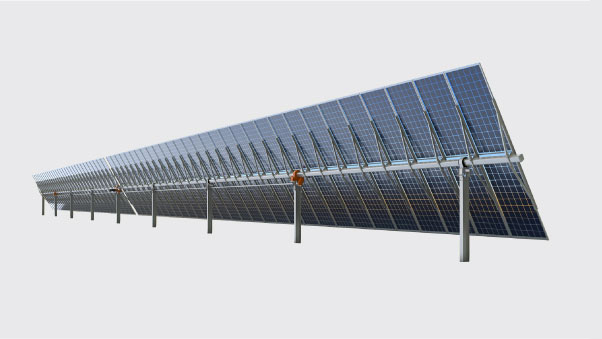
Description:
Independent Row 2P Tracker, Single Row, Double Performance, Triple Safety
SkySmartII tracking system is the first multi-point drive 2P tracking system in the industry. It completely solves the aeroelastic instabilities that traditional single fixed-point 2P trackers observe under high wind events. While ensuring the stability of the system, with the 182/210 large modules, it brings the capacity of a single system from more than 30 KW into 60 KW+. 4 strings helps reducing electrical mismatch losses, when compared with typical 3 string trackers. At the same time, it reduces foundations by 52%, when compared with traditional 1P solutions. SkySmart II has been engineered to be a perfect match for the new generation artificial intelligence solution, which enables up to 7% of additional energy generation.
| SKYSMART II TRACKER SPECIFICATIONS | |
|---|---|
| Tracking Type | Independent horizontal single-axis tracker |
| Tracking Range | 士 60° |
| Driving System | Slewing drive, parallel multi-point design, with 4*1,500 strings of solar modules |
| Modules per Tracker | Up to 120 modules per tracker |
| System Voltage | 1000 V or 1500 V |
| Ground Coverage Ratio | Typical ≥35% |
| Foundation Options | Ramming/Pre-drilling/Concrete Piles |
| Terrain Adaption | Up to 20% N-S Slope |
| Structure Material | Hot dipped galvanized/Pre-galvanized steel |
| Power Supply | Powered by PV strings, back-up Li-ion battery |
| Power Consumption | Typical 0.04kWh/day |
| Standard Design Wind Speed | 105mph (47m/s) per ASCE7-10, higher wind load available |
| Module Supported | All commercially available modules |
| Operation Temperature | -20℃ – 60℃ (-30℃ – 60℃ Optional) |
| ELECTRONIC CONTROLLER SPECIFICATIONS | |
|---|---|
| Control System | 1 controller per tracker |
| Control Algorithm | Astronomical algorithms + Tilt sensor close loop |
| Tracking Accuracy | ≤ 2° |
| Backtracking | Yes |
| Communication Options | LoRa wireless/ RS 485 cable |
| Night Position | Yes |
FIXED-TILT SOLAR RACKING SYSTEMS
Wireless Synchronous Seasonal-Tilt Structure
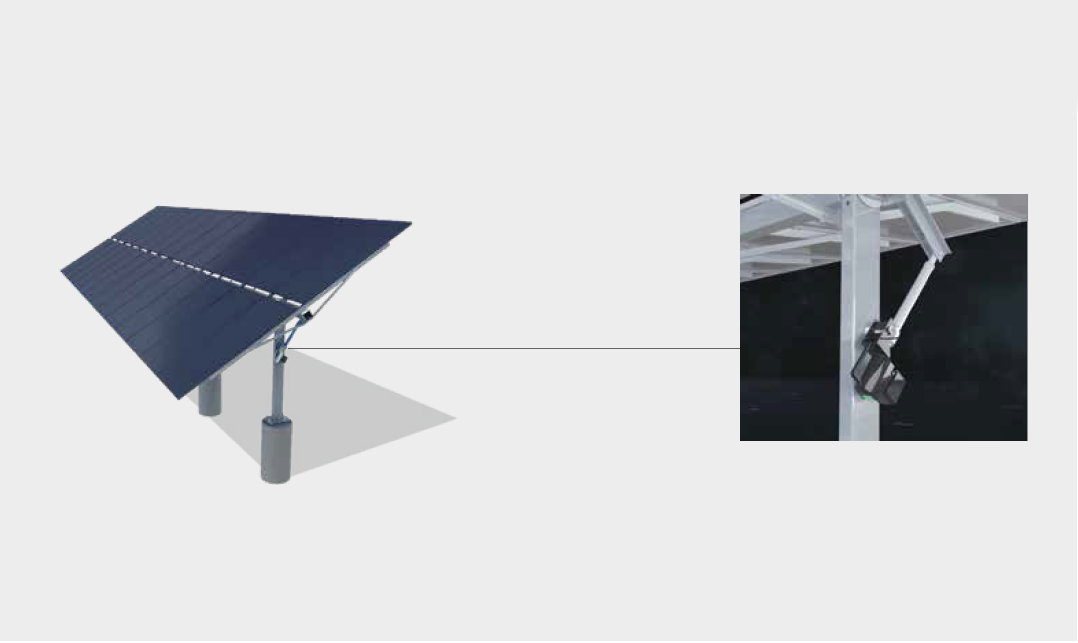
Description:
No Connecting Rod, Independent Pushrod, Simple Structure, One-Button Angle Adjustment,
The wireless synchronous seasonal-tilt structure consists of four main components, column post, main beam, purlin and synchronizing push rod. This patent design features a plug-and-go programmable independent angle adjustment equipment, allows the user to program 4 different angle, and adjust each row to the designated angle with a single click, Arctech’s seasonal-tilt structure can help customers maximize the benefits of their systems, generating more revenue with higher energy yield.
Fixed Tilt Structure
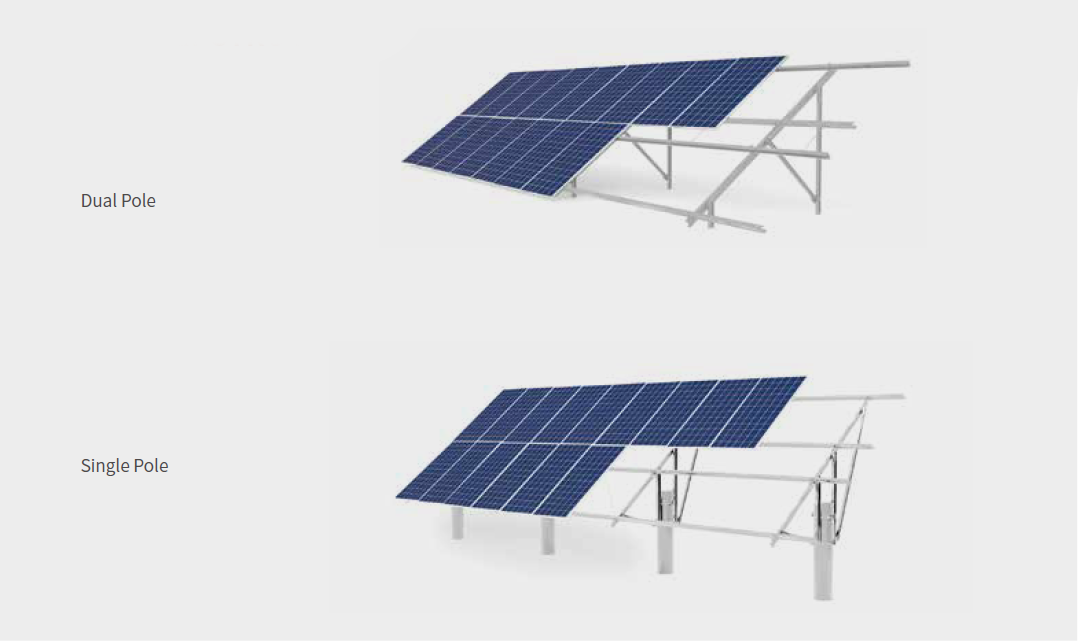
Description:
Excellent adaptability, High level of pre-assembly, Fast installation, No welding at project site, No land leveling required
The dual pole solution is currently the most popular fixed structure due to providing the best trade-off performance and high reliability. The single pole solution is engineered for quick installation. Its unique adjustable connection design enables Arctech’s single pole solution to flexibly cope with different terrains.
Building Integrated Photovoltaics (BIPV)
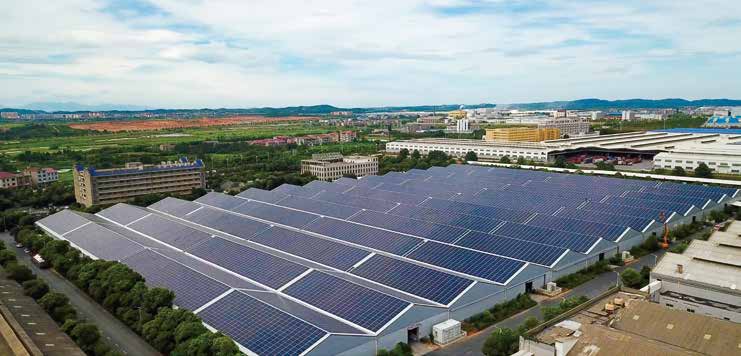
BIPV Smart Rooftop II
Description:
Arctech has been designing and deploying BIPV solutions since 2016, it is currently at a level of optimization that matches full-compliance with conventional building standards in terms of protecting from leakage, sedimentation and thermal expansion. Arctech’s BIPV offers a seamlessly integrated PV roof whose performance is the same as a traditional roof with the added benefit of renewable energy generation. Transform your rooftop into a photovoltaic power station. It is applicable to brand new buildings and roof retrofitting of existing buildings.
Eight Major Benefits for Business Owners
- Continuous benefits from photovoltaic power generation
- Savings on rooftop maintenance cost and time
- Extensions of rooftop life expectancy from 10 years to 25 years
- Great improvement of the roof thermal insulation effect
- Peak load shaving to increase investment income in electricity price
- Contribute to the society and relieve the pressure of peak power consumption
- Become low-carbon & environmentally friendly enterprise and get carbon emission credits
- Increasing social popularities and attentions of green buildings
BIPV System Advantages
Parameter comparison
| DESCRIPTIONS | BIPV | BAPV | COLOR STEEL TILE |
|---|---|---|---|
| Steel Load on Building |  |  |  |
| Withstand External Load Capacity |  |  |  |
| Upfront Investment |  |  |  |
| Generation Capacity |  |  | × |
| Years Of Use | 25 Years | 10 Years-15 Years | 10 Years-15 Years |
| Post-maintenance | √ | √ | × |
 Solar Trackers Global